
Degaussing Vs. Shredding: Which One Should You Choose?
Degaussing Vs. Shredding: Which One Should You Choose?
Degaussing vs shredding is one of the most important decisions businesses face when it comes to secure data destruction. Choosing the wrong method can leave sensitive data recoverable, exposing organizations to data breaches, compliance risks, and serious financial penalties.
In this guide, we explain the difference between degaussing vs shredding, how each method works, and when to use them. So, you can select the safest option for your organization. For a full overview of compliant processes, see our secure HDD destruction services.
Let’s dive in.
read more: how much gold is used in electronics
_result(1).webp)
What Is HDD Degaussing?
HDD degaussing is a data destruction method that uses a powerful magnetic field to permanently erase data from a hard drive. The drive is placed inside a degausser, which disrupts the magnetic patterns on the platters and makes all data unreadable.
After degaussing, the drive becomes inoperable and the data cannot be recovered, even with forensic tools. This method meets high-security standards such as NIST 800-88 and is widely used in regulated industries.
read more: types of data centre networks
Best for
Traditional magnetic hard disk drives (HDDs)
Magnetic backup tapes
High-volume data center decommissioning
Drives that are damaged or cannot power on
Organizations with strict compliance requirements (finance, healthcare, government)
Not Effective for
Solid-state drives (SSDs)
USB flash drives and memory cards
Optical media such as CDs and DVDs
Situations where drives need to be reused or resold
Modern HDDs if an outdated or low-strength degausser is used
What is HDD Shredding?
HDD shredding is a physical data destruction method that breaks hard drives into small pieces so the data cannot be recovered. The drive is placed into an industrial shredder, where strong blades cut the platters, circuit boards, and casing into fragments.
Once shredded, the data is permanently destroyed and the drive cannot be reused. Because the drive is visibly destroyed, shredding provides clear proof of data destruction and complies with strict certificates of data destruction such as NIST 800-88.
Shredding works on all storage technologies and does not rely on how data is stored, making it one of the most universal data destruction methods.
Best for
All storage media types (HDDs, SSDs, tapes, USBs, CDs/DVDs)
SSDs and flash-based devices that cannot be degaussed
Mixed-media environments
High-compliance requirements needing physical proof
On-site destruction where audit visibility is important
Large-scale destruction using industrial or mobile shredders
Not Effective for
Situations where drives need to be reused or resold
Organizations aiming to recover asset value from hardware
Environments without proper recycling processes
Extremely high-security use cases unless small particle sizes are used
_result(5).webp)
Degaussing vs Shredding: Key Comparisons
Now that both methods have been explained, it’s easier to see how degaussing vs shredding differ in real-world use. The table below compares them across the key factors that matter most when choosing a destruction method.
Choosing the Right Data Destruction Method for Your Needs
Choosing between degaussing vs shredding depends on your media type, data sensitivity, compliance needs, volume, and budget. Follow these steps to decide.
1. Identify Your Media Types
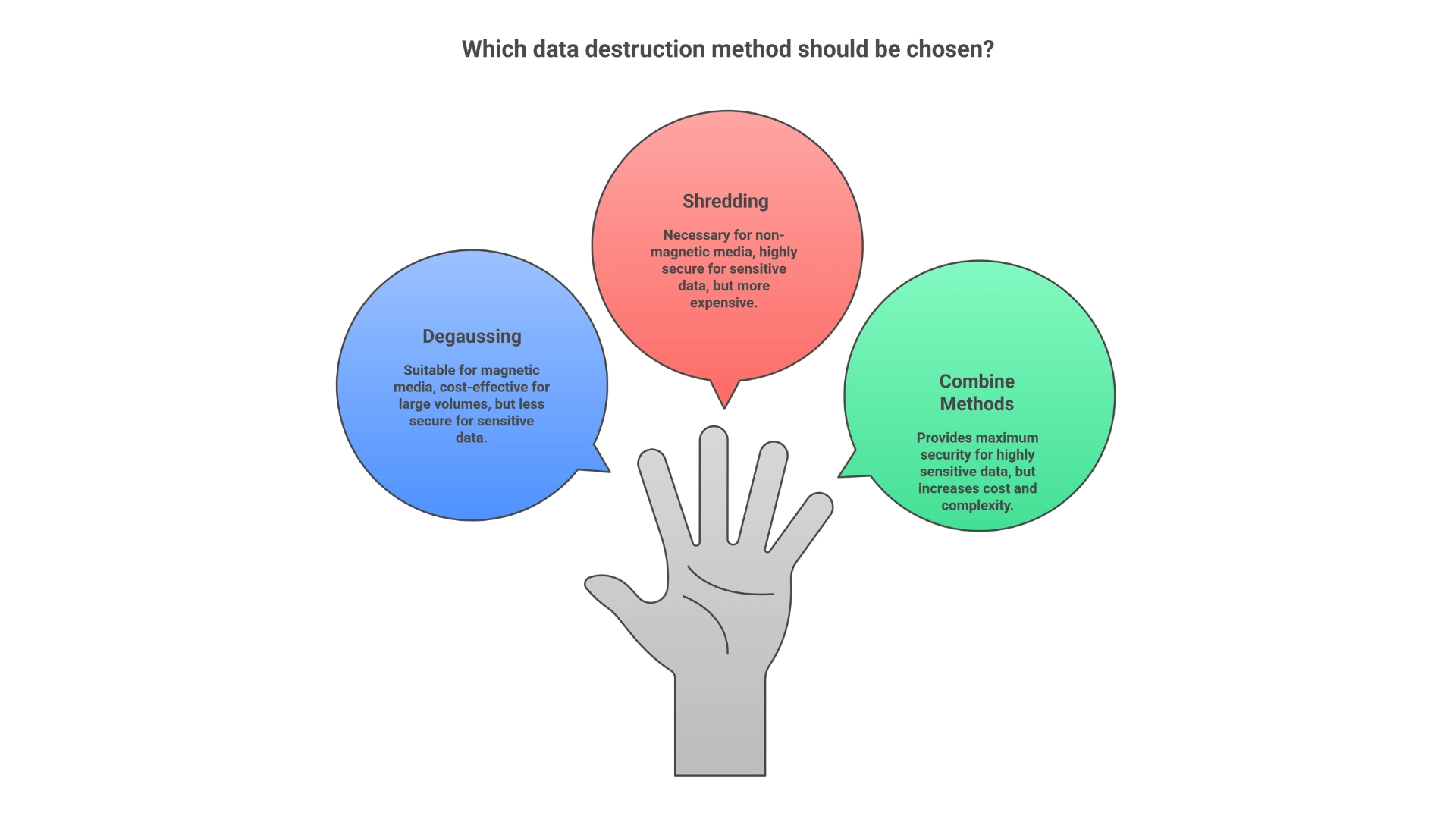
Start by listing the devices you need to destroy. Degaussing only works on magnetic media like HDDs and tapes. If you have SSDs, USB drives, optical discs, or mobile devices, shredding is required. If your assets are mixed, shredding is usually the safest option.
our services: data center decommissioning
2. Consider Data Sensitivity & Compliance
Highly sensitive or regulated data often requires physical destruction. In strict environments, organizations may degauss HDDs first and then shred them for extra assurance. For lower-risk data, degaussing alone may be acceptable if allowed by your policies and supported by proper documentation.
3. Evaluate Volume & Logistics
If you handle large volumes of HDDs regularly, degaussing is fast and efficient. For small batches or one-time projects, professional shredding services are usually more practical. When data must not leave the site intact, on-site destruction is recommended.
4. Assess Cost Versus Value
Degaussing equipment is generally cheaper and easier to maintain, while shredding involves higher equipment or service costs. Choose the method that meets your security needs first, then optimize for cost.
5. Decide between In-house Or Professional Services
In-house destruction gives full control but requires trained staff and equipment. Professional services offer convenience, compliance documentation, and secure chain-of-custody, which is often preferred for audits.
6. Combine Methods When Security Risk is High
When the stakes are high, using both degaussing and shredding provides maximum peace of mind. This approach is common in government, healthcare, and financial sectors.
7. Plan for Verification And Records
Always document the destruction process. Keep serial number logs, Certificates of Destruction, and audit records to prove compliance and protect your organization.
our services: it asset recovery
Final Thoughts
In conclusion, you must choose the method that best matches your media type, security risk, and operational needs. Degaussing and shredding are not alternatives to each other; they work best as complementary tools.
By understanding how each method works, you can select the right approach and ensure your data is destroyed securely and in line with your business and compliance requirements.
FAQs
What Is the Most Secure Method of Data Destruction: Degaussing or Shredding?
Both methods are highly secure for hard disk drives (HDDs) when done correctly. Degaussing completely erases data on magnetic drives, while shredding physically destroys the drive. Neither has a security advantage over the other for HDDs. Shredding is required for SSDs and other non-magnetic media. For very sensitive data, some organizations use both methods for extra assurance.
Can Degaussing Be Used for SSDs or Flash Drives?
No. Degaussing does not work on SSDs, USB flash drives, or memory cards because they do not store data magnetically. These devices must be physically destroyed, such as by shredding or crushing, to ensure data cannot be recovered.
Should I Degauss Hard Drives Before Shredding Them?
In most cases, no. Either degaussing or shredding is enough when done correctly. Using both is usually needed only for very sensitive or classified data.
Degaussing removes the data, and shredding afterward gives visible proof that the drive is destroyed. For normal business data, one method is sufficient as long as it follows approved standards and is properly documented.

Ask an Expert
Call us 24/7 or submit the form below to speak with one of our specialists.
All fields required
_result_result.webp)
.png)