Healthcare ITAD Services

Rapid Solutions International Healthcare ITAD
 
 
ePHI

Rapid Solutions International

Healthcare ITAD: Secure IT Disposition for Hospitals, Clinics, and Laboratories

Protect patient data, control retired assets, recover value, and recycle medical electronics responsibly — with documented chain of custody.

See Our Process
SECURE

Why it is different

Not a normal office cleanout

Hospitals, clinics, laboratories, and medical offices rely on technology for patient care. When electronics become old, damaged, replaced, or unused, they still carry risk.

A retired laptop may contain patient information. An old server may hold backups, access records, logs, or electronic protected health information. Even a nurse’s tablet can retain sessions, files, or application data.

HIPAA Security Rule requires policies for removing, moving, reusing, and disposing of hardware and electronic media that contain ePHI — and for removing ePHI before media is reused.

Key advantages

What strong Healthcare ITAD delivers

Rapid Solutions shapes healthcare projects around verified sanitization, controlled movement of assets, responsible reuse, and audit-ready reporting.

01

Protect ePHI

Patient information can remain on laptops, servers, storage, tablets, printers, copiers, smartphones, scanners, backups, and selected medical systems. We apply verified sanitization or physical destruction based on device type, condition, and reuse potential.

02

Maintain Chain of Custody

Assets should not leave a facility without control. They are recorded, collected, transported, processed, and reported through documented chain-of-custody procedures.

03

Recover Asset Value

Usable laptops, desktops, servers, monitors, storage, and networking gear can be tested, refurbished, and remarketed after secure data removal.

04

Recycle Responsibly

Non-reusable assets move through documented recycling channels instead of general waste or uncontrolled downstream processes.

Key takeaways

Challenges and solutions

HIPAA is central for covered entities and business associates handling ePHI. HITECH strengthens enforcement and breach-notification expectations. Other rules such as FISMA may apply depending on the organization.

ChallengeePHI may remain on retired devices.
SolutionUse Healthcare ITAD and HIPAA-aligned disposal with verified data sanitization.
ChallengeLimited proof of disposal.
SolutionKeep asset reports, chain-of-custody records, and certificates of destruction.
ChallengeMedical devices need special review.
SolutionUse medical equipment recycling services with biomedical or manufacturer coordination.
ChallengeData may remain beyond EHR systems.
SolutionInclude printers, phones, backup drives, and storage in hospital IT asset disposal.
ChallengeDevices can be lost or untracked.
SolutionApply inventory, secure collection, and chain-of-custody controls.
ChallengeDeleted data may still be recoverable.
SolutionUse verified wiping or physical destruction through healthcare data destruction services.
ChallengeElectronics may enter general waste.
SolutionUse certified recycling and documented ITAD services.
ChallengeUsable assets may be wasted.
SolutionUse healthcare ITAD remarketing and value recovery before recycling.

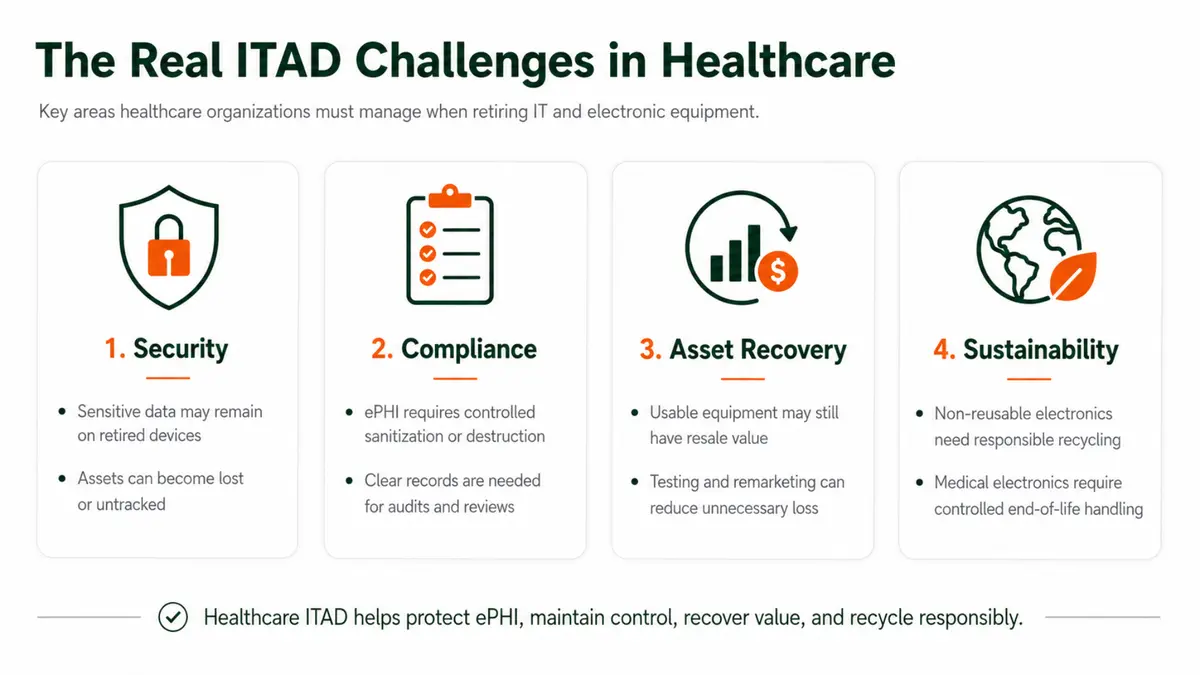
The real challenges

Security, compliance, and environmental risk

Healthcare ITAD challenges across security, compliance, asset recovery, and sustainability
#1

Data Security Challenges

  • Patient data can remain on printers, backup drives, smartphones, mobile carts, scanners, and network storage — not only EHR systems.
  • Equipment may move between departments and sites without proper records and disappear before entering the correct ITAD process.
  • Deleting files, formatting a drive, or resetting a device may not fully remove sensitive information.
#2

Compliance Challenges

  • Laptops, servers, tablets, printers, copiers, and storage can still contain patient information after they leave service.
  • Providers may lack clear records of how a device was collected, sanitized, destroyed, or recycled.
  • Medical devices can include patient data, licenses, calibration records, or manufacturer restrictions that complicate recycling.
#3

Environmental Challenges

  • Monitors, batteries, cables, printers, and medical electronics may enter general waste instead of responsible recycling.
  • Non-data-bearing devices such as pulse oximeters, glucose monitors, and displays still need controlled end-of-life handling.
  • Reusable technology can become unnecessary e-waste without remarketing and value recovery.
192.7M

Why it matters now

Healthcare ITAD is part of risk management

192.7M+

HHS reported that more than 192.7 million individuals were affected by large healthcare breaches in 2024, with major increases in hacking and ransomware impact in recent years.

“The protected health information of more than 62 million Americans was compromised in the incident, making it the third-largest healthcare data breach of all time. Mega data breaches were also announced in 2025 by Aflac, which affected almost 14 million individuals — the 5th largest healthcare data breach of all time, and Episource, which affected more than 6.7 million individuals.”

Not every breach comes from a retired laptop. Still, uncontrolled old assets create an avoidable weak point. A well-managed healthcare ITAD process supports:

  • Protecting patient information
  • Supporting HIPAA-aligned IT disposal in the United States
  • Reducing lost or untracked devices
  • Creating better asset records
  • Recovering value from reusable equipment
  • Keeping electronics out of uncontrolled waste streams
  • Clearer documentation for IT, compliance, finance, and procurement
  • Treating ITAD as risk management — not only disposal

Our process

Healthcare ITAD, end to end

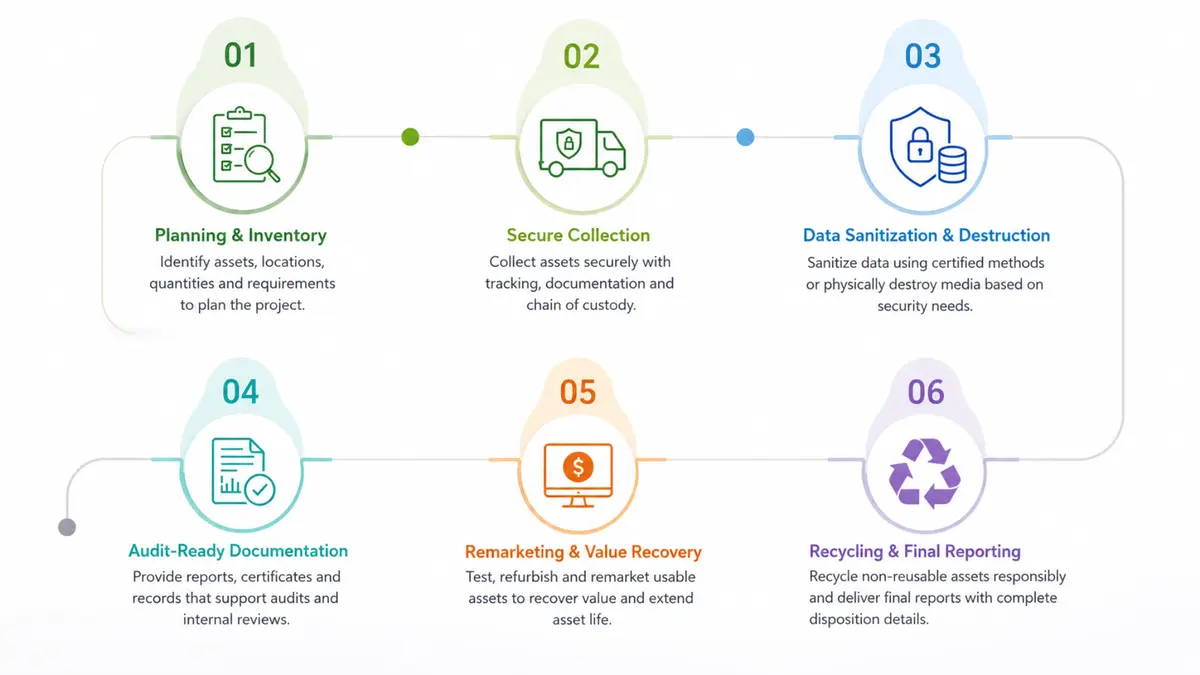
Rapid Solutions International provides ITAD services shaped around data security, asset tracking, controlled collection, responsible reuse, and recycling for healthcare clients.

Six-step healthcare ITAD process from planning through final reporting
1

Planning and Inventory

We align on locations, departments, equipment types, quantities, data-bearing devices, security needs, on-site requirements, collection schedule, reporting, and approved disposition methods. Records may include manufacturer, model, serial, asset tag, storage type, condition, location, and disposition method.

  • Project locations
  • Security requirements
  • Serialized inventory
  • Shared project scope
2

Secure Collection

Controlled removal with scheduled, multi-department, and multi-site collection; serialized recording; secure loading; controlled transport; chain-of-custody documentation; and on-site destruction where required.

  • Chain of custody
  • Secure loading
  • Multi-site pickup
3

Data Sanitization and Destruction

Data-bearing assets are reviewed for the right method — wipe for reuse, physical destruction for failed drives, or on-site destruction for highly sensitive media. Hard drive wiping follows NIST 800-88, R2v3, ISO 27001, and ADISA-related standards with an audit trail.

  • Verified wiping
  • Cryptographic erasure
  • HDD / SSD destruction
  • Serial-level reporting
4

Audit-Ready Documentation

Evidence for later questions: asset lists, serial numbers, pickup records, chain of custody, wiping reports, certificates of destruction, recycling records, remarketing reports, and value recovery summaries.

5

Remarketing and Value Recovery

After approved sanitization, usable assets can be tested, refurbished, and remarketed — recovering value and reducing unnecessary e-waste. Remarketing always follows data security, never before.

6

Recycling and Final Reporting

Damaged, incomplete, outdated, or uneconomical assets go to responsible recycling, with final inventory, certificates, and disposition reports for IT, compliance, finance, procurement, and auditors.

ASSETS

Coverage

Assets we manage

From everyday IT to specialized clinical electronics — virtually any healthcare equipment with a cord, battery, power supply, or power switch.

Computers & tabletsPatient-room TVs & monitorsIV pumpsPrinters, copiers, scanners, faxPulse oximetersPhones & pagersX-ray equipmentPET / MRI / CT / UltrasoundDiagnostic imagingEKG & ECGVital sign monitorsRespiration monitorsGlucose devicesWearable sensorsPortable electronicsPhysical therapy devicesDefibrillatorsMedical handheldsClinical workstationsMobile medical cartsBiomedical testingLab measurement gearClinical chemistryHematology & urinalysisEndoscopyElectronic surgical instrumentsHealthcare communication devicesEmbedded storage from medical systemsPower supplies, boards, cables, batteries

Medical equipment recycling often needs biomedical or manufacturer coordination when licenses, calibration data, or device restrictions apply.

Certifications and Standards

  • R2v3 for responsible reuse, data security, and downstream management
  • NIST SP 800-88-aligned data sanitization
  • ISO 27001 information security
  • ISO 9001 quality management
  • ISO 14001 environmental management
  • ISO 45001 occupational health and safety
R2v3 NIST 800-88 ISO 27001 ISO 9001 ISO 14001 ISO 45001

Documented chain of custody, sanitization, destruction, and reporting can support HIPAA and HITECH efforts — but an ITAD provider alone cannot make an organization HIPAA compliant.

Why Rapid Solutions

  • Secure collection & chain of custody — tracked from pickup through final processing
  • Verified wiping & destruction — based on security requirements
  • Testing & value recovery — remarket reusable equipment
  • Responsible recycling — documented channels for non-reusable electronics
  • Audit-ready documentation — asset reports, wiping records, certificates
  • Certified processes — R2v3 and ISO-certified management systems

FAQs

Questions healthcare teams ask first

Is deleting files enough to protect ePHI?

No. Deleting files does not necessarily remove the underlying data from a storage device. Secure data sanitization or physical destruction may be required depending on the device and your security requirements.

What healthcare devices may need secure ITAD services?

Laptops, desktops, servers, storage devices, phones, tablets, printers, copiers, networking equipment, data center hardware, medical electronics, imaging systems, and related electronic assets.

What documentation is provided after data destruction?

Documentation may include certificates of data destruction, asset reports, serial number records, chain-of-custody details, recycling certificates, and final disposition reports.

Can an ITAD provider make a healthcare organization HIPAA compliant?

No. HIPAA compliance depends on the organization’s full privacy, security, workforce, risk-management, and vendor-management program. HIPAA-aligned IT disposal practices can support compliance when they include proper handling, documented sanitization, controlled asset movement, and clear records.


Before any healthcare device leaves your facility

Confirm where sensitive data is stored and whether it needs verified sanitization or physical destruction. Rapid Solutions can help define a controlled process for protecting ePHI, maintaining chain of custody, and documenting final disposition.

We and selected partners, use cookies or similar technologies as specified in the cookie policy.